Anchoring Change
Schools across Canada are facing increasingly complex substance use challenges but have lacked a shared approach to prevention, education, and intervention.
To address this need, Wellstream: The Canadian Centre for Innovation in Child and Youth Mental Health and Substance Use at the University of British Columbia brought together national partners—including the Canadian Centre on Substance Use and Addiction (CCSA), the Canadian Association of School System Administrators (CASSA), Physical and Health Education (PHE) Canada, and the Students Commission of Canada —to launch Anchoring Change, a collaborative initiative advancing evidence-informed approaches to school-based substance use prevention, education, and intervention
A national initiative to transform school-based substance use prevention, education, and intervention in Canada
A national initiative to transform school-based substance use prevention, education, and intervention in Canada





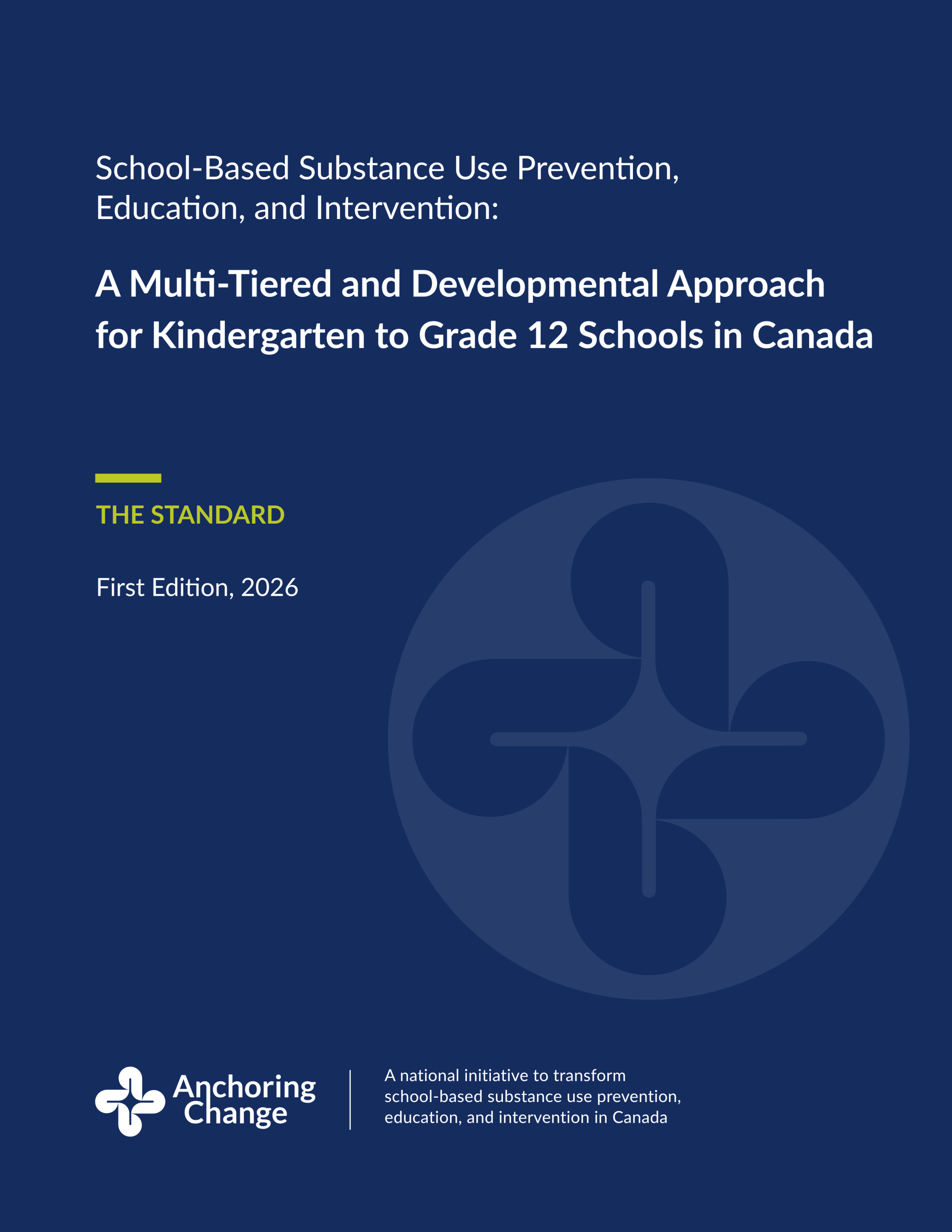
The Standard
School-Based Substance Use Prevention, Education, and Intervention: A Multi-Tiered and Developmental Approach for Kindergarten to Grade 12 Schools in Canada
School-Based Substance Use Prevention, Education, and Intervention: A Multi-Tiered and Developmental Approach for Kindergarten to Grade 12 Schools in Canada
The Standard is just the beginning.
Explore the milestones below to learn how it was developed and what’s next for the Anchoring Change initiative.
Transforming Substance Use Harm Prevention in Schools:
A Multi-Phased Initiative
A Multi-Phased Initiative

Phase
1
Characterizing the Landscape & Guiding Innovation
AIM: Strengthen intersectoral partnerships, including with school-based professionals, substance use experts, and youth networks, to characterize current practices and distill evidence to inform the co-development of national standards for substance use education and intervention in K-12

Phase
2
Making the Change, Building the Solutions, & Evaluating for Impact
AIM: Realize systems transformation by enacting co-developed implementation processes to facilitate the ratification and adoption of national standards across education systems. Develop and test low-barrier, evidence-aligned prototype resources to support practice change, and trial a data strategy to assess impacts on education systems and youth substance use more broadly.

Phase
3
Optimizing Outcomes
AIM: Produce a framework for continuous monitoring and refine research and data processes, implementation products, and training to scale practice resources across education systems and respond to emerging trends to strengthen impacts.
Co-Creating Capacity for Change: A National Strategy for School-Base